
Business travel in 2026 is not simply recovering from the disruption of recent years - it is being fundamentally rewritten. Travel managers, finance leaders, and procurement teams are navigating a landscape where technology, sustainability, globalisation, and shifting workforce expectations are converging in ways that demand a smarter, more strategic approach to how organisations move their people. At Clarity, we work with hundreds of organisations across the UK and beyond, from public sector bodies and charities to major energy companies and professional services firms.
What we’re seeing points clearly to defining themes that will shape business travel and meetings programmes in 2026 and beyond.
Travel and meetings are being viewed together - and that’s changing everything
For years, corporate travel and meetings management sat in separate silos. Travel was booked through one organisation, meeting rooms and venues sourced through another, and the data never looked at in tandem. While many organisations have moved away from booking their travel and meetings separately, many still operate with multiple agents - and where they have consolidated their spend, one supplier doesn't always mean joined up thinking.
In 2026, we are seeing a growing and meaningful shift in how businesses think about their travel and meetings spend. Travel managers, finance directors, and procurement teams are beginning to ask questions they weren’t asking two years ago: What is the total cost of getting our people in the same room? Not just the flights and the hotel, but the venue, the ground transport, the associated meetings spend. The complete picture.
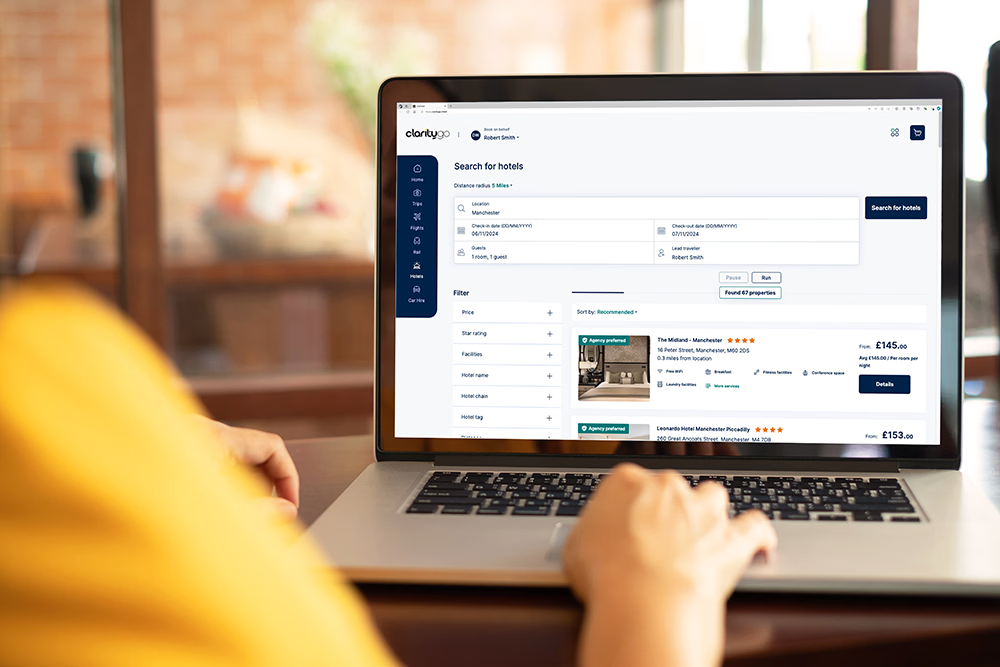
Businesses increasingly asking their TMC whether travel and meetings can be managed under one roof, with one strategic partner who understands both. We believe this convergence represents one of the most significant structural shifts in our industry right now. As a supplier of travel and meetings management capabilities, we’re investing in ensuring that more of that picture is visible from one organisation and one account manager, through our platforms ClarityGo and MeetingsPro.
For travel managers, the practical implication is this: if your meetings spend sits entirely outside your travel programme, 2026 is the year to start bringing those conversations together.
AI in corporate travel: Useful in the right places, unreliable in the wrong ones
Artificial intelligence has been a buzzword in corporate travel for several years - that grew exponentially with the emergence of generative AI capabilities like Claude, ChatGPT and others. Yet AI has actually been present in corproate travel services for some time. Refund robots, automated invoicing and predictive pricing - these are the tasks where AI performs well and adds real convenience for organisations. But, in 2026 the conversation is settling into something more honest - a thirst for more.
Historically, the moment a query becomes even slightly nuanced, the picture changes. A traveller stranded by a cancellation with a complex multi‑leg itinerary, a group booking that needs restructuring around a venue change, or a sensitive itinerary for a senior executive with specific requirements - these are not situations where AI can be relied upon. The variables are too many, the stakes too high and the need for human judgement essential.
The risk for travel managers is investing in AI‑led tools that perform impressively in a demo and underdeliver when it actually counts. The right question to ask any TMC about their AI capability is not “what can it do?” but “what does it hand off to a human - and when?”
We are clear‑eyed about this and balance it perfectly - technology should be smart and reliable, but people should be there for the more complex. That boundary is good service design. That isn't to say that's the end of the AI conversation i business travel. It's safe to say that conversation will increasingly more interesting as 2026 goes on.
SMEs and mid‑market companies are underserved - and starting to push back
One of the most notable shifts in the UK corporate travel market is the growing frustration among small and mid‑sized businesses with the solutions available to them.
For too long, the TMC market has operated in two distinct modes: mega agencies with enormous client bases, global infrastructure, and a one‑size‑fits‑all approach; or small independent agencies without the technology, buying power, or specialist expertise to properly manage a complex travel programme. For SMEs neither option has ever fit well.
Mega TMCs bring scale, but they also bring rigidity. A mid‑sized engineering firm with a project team travelling internationally every week has different needs from a professional services firm with mainly domestic travel. They need a programme designed around their business, not a product built for clients ten times their size. They need an engaged account management team - proactive, agile, and strategic - not a reactive helpdesk.
At the same time, new, genuinely powerful booking technology has levelled the playing field. Many TMCs can now offer the content breadth, policy management, data reporting, and duty of care capability once reserved for the industry giants - combined with the personal service and flexibility the largest players have largely abandoned. In fact, the giants can no longer compete in the same way for customers looking for flexibility without major, expensive developments of tools they don't own.
We are now seeing real market movement. Increasingly, SME and mid‑market clients are asking whether their TMC was actually built for them, or whether they are simply a line item in a much larger portfolio.
If you are an SME or growing mid‑market business reviewing your travel programme in 2026, the most important question to ask a prospective TMC is simple: Can you show me how you manage a customer like us?
The people‑technology balance remains the central solution
Every TMC in 2026 claims to have great technology and great people. Few achieve the right balance.
Self‑booking tools, AI automation, and digital itinerary management have made parts of corporate travel faster and more efficient. But business travel remains fundamentally human - involving real people, in unfamiliar places, under pressure, sometimes in unpredictable situations. When a traveller’s flight is cancelled in a city they don’t know, or a group booking begins to unravel 48 hours before departure, the quality of the human response matters more than any technology.
The best travel programmes are honest about this. They use technology for the routine - online booking, policy compliance, approvals, real‑time reporting - and reserve human expertise for the complex, the urgent, and the strategic. The job of a TMC is not to replace humans; it is to free skilled people to do what only skilled people can do.
At Clarity, this has always been our philosophy. Our teams combine experienced consultants, meetings specialists, and dedicated account managers with a technology platform designed to make routine tasks effortless. The aim is not to remove people from the equation - it is to ensure they spend their time where they make the biggest difference.
Global ambitions require local expertise - and a smarter model of TMC support
For growing businesses, one of the most persistent challenges in corporate travel is scaling globally. When organisations expand into new markets - opening an office in Singapore, running teams in the Middle East, or managing executive travel across Europe - their travel programme often struggles to keep pace.
Traditionally, the answer has been the global mega agency: a single TMC with owned operations worldwide, a single contract, and a promise of consistency. In reality, buyers often find that global consistency becomes global uniformity - rigid systems, limited local knowledge, and the experience of being a small account in a very large machine.
There is a better model: global travel management built on local expertise delivered consistently at scale.
This is the foundation of One Global, the international joint venture co‑founded by Clarity and US‑based World Travel, Inc. Rather than owning operations everywhere, One Global brings together leading independent TMCs in each region - each with strong local expertise and market presence. The result is a single, unified service with consistent data, technology, and account management - but with every booking and traveller support call handled by people who truly understand the local market.
This model is built for the businesses mega agencies have never served well: ambitious SMEs, growing mid‑market corporates, and emerging global enterprises. Clients who want genuine local expertise, not a distant outpost of a global machine. Clients who want account management that understands their business, not a call centre routing queries across time zones.
One Global now spans Europe, South America, the Middle East, Africa, Asia, and Australasia - enabling Clarity to support clients with international travel demands far beyond what a UK‑only TMC could deliver.
Sustainability: From reporting to programme design
Sustainability in corporate travel has moved from a nice‑to‑have to a regulatory requirement. In 2026, for many organisations - especially those within the scope of the Corporate Sustainability Reporting Directive (CSRD) - it is now a legal and financial obligation.
The CSRD requires companies to report on Scope 3 emissions, including business travel across air, rail, accommodation, ground transport, and meetings. This shifts sustainability from general statements about reducing emissions to the detailed work of measuring, reporting, and reducing them.
For travel managers, this is both a challenge and an opportunity. The challenge is securing complete, accurate emissions data across all travel channels. The opportunity is that organisations who get this right can manage suppliers better, make smarter purchasing decisions, and demonstrate real progress to stakeholders.
Traveller behaviour is shifting, too. Businesses with strong sustainability programmes are seeing more employees choose rail over short‑haul flights when presented with clear options. Green hotel accreditation is becoming a meaningful factor in accommodation choice.
Importantly, sustainability and cost control are not in conflict. Reduced unnecessary travel, improved policy compliance, and increased rail usage can cut emissions and costs simultaneously. Organisations that understand this are building sustainability into the core design of their travel programmes, not treating it as a standalone ESG activity.
What this means for your travel programme in 2026
The common thread across all six trends is clear: business travel is becoming more strategic. Organisations that treat it as such will be better positioned - commercially, operationally, and reputationally - than those who continue viewing it as a simple purchasing function.
Whether you are reviewing your TMC, rebuilding your travel policy, or integrating travel and meetings management, the key questions are more defined than ever:
- Does your TMC understand your business, or just your spend?
- Does their technology solve real traveller problems, or merely generate dashboards?
- Can they support international growth without losing the responsiveness and local knowledge that make the relationship work?
These are the questions that define effective travel management in 2026. They are the questions we ask ourselves every day at Clarity.
Want to explore how we can support your travel programme in 2026? Book a conversation with our team or explore our travel management services.